

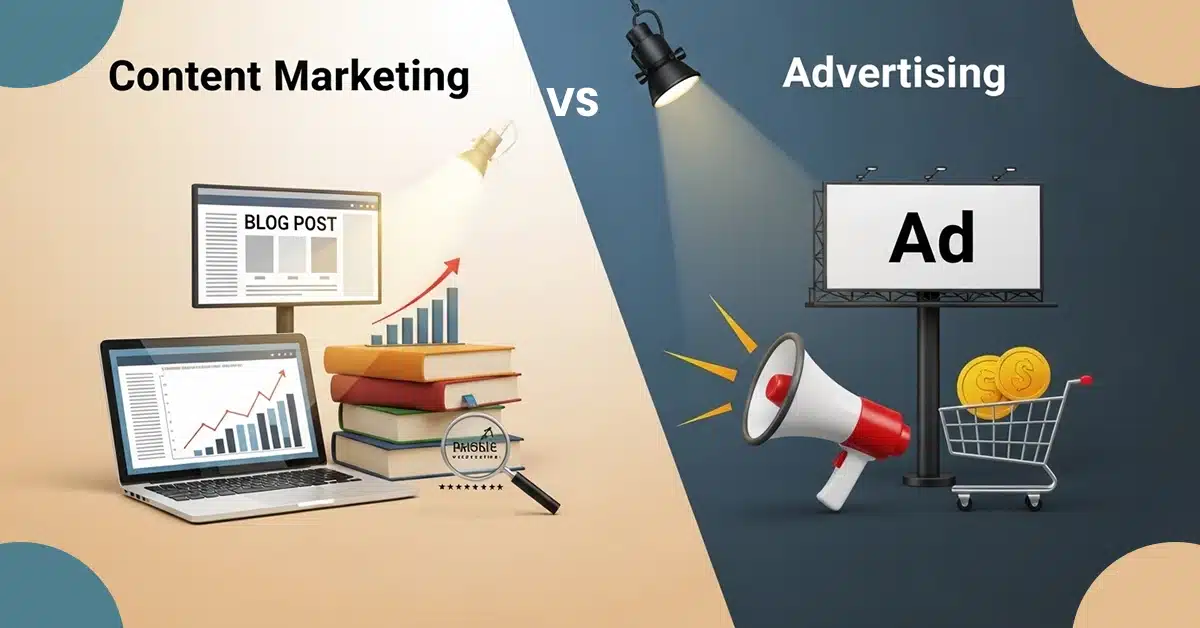
Businesses often face this dilemma of choosing between content marketing and advertising. While paid ads give immediate visibility, content marketing provides an organic and more relationship-focused approach that compounds over time.
The right choice between content marketing vs advertising depends on a business’s needs. So, in this guide, we’ll walk you through the key differences between the two strategies to help you make an informed decision.
30-Second Summary
- Content marketing builds long-term growth, while advertising offers fast yet temporary results.
- Advertising stops when the budget stops, but high-quality content continues to generate traffic over time.
- Refreshing content is more cost-effective than constantly replacing ad creatives, making content more scalable in the long run.
- The most effective strategy combines both approaches, using ads for immediate visibility and content marketing for sustainable growth.
What is Content Marketing?
Content marketing is a major component of an inbound marketing strategy, designed to attract and engage your target audience with relevant, helpful, and valuable content. Instead of directly selling, it educates, informs, or entertains the users so they naturally discover your brand.

As per studies, B2B content marketing generates three times more leads than traditional marketing and saves 62% of overall expenses in the process.
Content marketing is all about creating wide-ranging and compelling content, including
- Blog posts and SEO articles
- Social media content
- Email newsletters
- Videos and podcasts
- E-books and guides
- Case studies
- White papers
- Easy-to-read graphics
- Online seminars
How Inbound Marketing Works
Content marketing basically pulls customers in through high-quality content that people actively search for. This builds trust and positions your company as a helpful authority instead of a salesperson. Over time, this content compounds and brings solid organic traffic and consistent leads.
What is Advertising?
Online advertising is different from content marketing. It is a type of outbound marketing where you pay an external source to display your advertisements. You do not own the platforms on which these ads are published.
Instead of waiting for people to find your brand, advertising pushes your messages in front of them to get discovered.

The common types of advertising include
- Paid search advertising (Google Ads, Bing Ads)
- Paid social ads (Facebook, TikTok, Instagram, and LinkedIn)
- Display and banner ads
- Video ads (YouTube and OTT platforms)
- Sponsored placements and native ads
Inbound vs Outbound Marketing Differences
| Factor | Content Marketing (Inbound) | Advertising (Outbound) |
| Approach | Attracts users | Interrupts users |
| Trust level | Higher | Lower |
| Cost over time | Decreases | Increases |
| Longevity | Long-term | Short-term |
| User intent | High | Mixed |
| Relationship building | Strong | Limited |
Content Marketing Strategy vs Advertising Strategy
The major difference between the two strategies lies in the way they are created.
Content Marketing Strategy
A content marketing strategy is designed around the following.
- Keyword research and SEO planning
- Topic clusters and authority building
- Audience education across all funnel stages
- Content calendars
This is how you create a great content marketing strategy.

Step 1: Start by identifying your business’s goals. The strategy won’t succeed if it doesn’t align with the organization’s goals.
Step 2: Set the content marketing objective that your business executives want to achieve. At this stage, you are looking for a general objective, not a specific topic or tactic.
Step 3: Define your audience because targeting a broad one is not effective. You should create as many audience segments as possible to target your audience clearly.
Step 4: This is the stage where you start identifying content categories and topics. Brainstorm ideas that your audience will like reading, watching, or hearing about.
Step 5: Decide what content types and formats your audience will consume and fit within your available resources. If your audience likes videos, your content should revolve around that.
Step 6: After selecting a format, decide on the distribution channels where you will upload the content. Also, pick a posting frequency (how often you will publish the content) that is realistic.
Step 7: Now, you go back to the beginning and connect all of it with your business’s purpose. Consider what you want your audience to do after consuming your content, how you will measure success, your specific goals, and how much time you want to invest to achieve them.
Advertising Strategy
An advertising strategy focuses on
- Campaign setup and testing
- Creative testing
- Budget optimization
- Conversion tracking and scaling
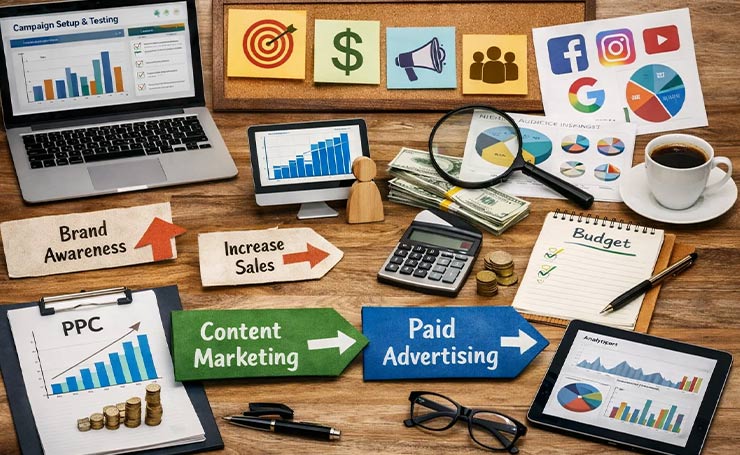
As there are different types of advertising strategies (PPC, social media marketing, native advertising, etc.), here is how you can choose the best one for your business.
- The first thing to consider is your marketing goals. Ask whether you want more brand awareness, increase sales, or drive traffic to your website. Your goals will help create an effective strategy.
- Understand who your audience is and where they spend their time online. This will narrow down the right marketing channels.
- See how much you can afford to spend on your ad campaigns. Some campaigns, like PPC, require more budget.
- Start with a few strategies and test which ones are working well. Analyze data and see what works and where the strategy needs adjustments.
- Select strategies that offer the best ROI (return on investment). It means that you focus on that approach that brings the best result without the need for overspending.
These two marketing strategies focus on long-term organic traffic (content marketing) vs paid ad traffic (advertising).
Content Marketing Benefits vs Advertising Benefits
Both marketing tactics have their benefits.
Content Marketing Benefits
- Content marketing focuses on the audience’s needs. It delivers value by addressing users’ pain points and challenges and solving their problems.
- This type of content marketing builds trust and authority over time. When you provide your prospects with good content, they keep coming back to learn more.
- Content marketing leads to better leads and customers. When your content aligns perfectly with the products and services you sell, visitors find solutions to their problems, increasing your business’s growth.

Advertising Benefits
- Ads instantly grab a user’s attention. They raise awareness of your brand and let people know about new products/services, upcoming events, and other things.
- Ads stimulate an emotional response, regardless of the format. They are powerful enough to make people cry, laugh, feel confusion, and experience any other emotion.
- Ads have persuasive messaging that encourages the audience to take specific actions. For example, you should design a YouTube ad in a way that the audience does not hit the “Skip Ad” button.
ROI and Cost Implications
Understanding the financial aspects of these strategies is important for proper budget allocation to get the best ROI.
Digital Advertising vs Content Marketing: Cost-Effectiveness
Advertising needs significant upfront investment for media production. The more money you invest in advertising, the more visibility and potential returns you get. However, the cost-per-acquisition (CPA) can be high, reducing the overall ROI.
The initial costs for content marketing are lower, as it focuses on content creation and organic traffic. When you invest in creating high-quality content over the long term, you see steady engagement and lower CPA. This marketing approach is also better for high ROI, as content keeps attracting and converting people with minimal investment.
Digital Advertising vs Content Marketing: Measuring ROI
For advertising, you need to track metrics such as clicks, impressions, conversion rates, and sales generated by the campaigns. The KPIs that indicate advertising effectiveness are CPA and Return on Ad Spend (ROAS).
For content marketing, measure visitors’ engagement using time on site, social shares, conversion rates, and shares of content pieces. To judge the effectiveness of content marketing, track KPIs, including Customer Lifetime Value (CLV) and Cost per Lead (CPL).

To better understand how content marketing and advertising differ in real-world performance, let’s compare blog content vs banner ads through the lens of ROI, cost-friendliness, effectiveness, and traffic.
| Factor | Blog Content (Content Marketing) | Banner Ads (Advertising) |
| ROI Over Time | Increases over time as content ranks, gains backlinks, and attracts recurring visitors | Declines over time as ad fatigue sets in and performance drops |
| Traffic Source | Organic, search-driven, and repeat traffic | Paid, impression-based, and temporary traffic |
| Traffic Longevity | Long-term; traffic continues even after the publishing cost is recovered | Short-term; traffic stops immediately when ad spend ends |
| Effectiveness | High for awareness, trust-building, and qualified leads | High for visibility and quick exposure, lower for trust |
| Cost-Effectiveness | High in the long run, the cost per visit decreases over time | Lower long-term cost-effectiveness due to continuous spending |
| Cost Structure | One-time creation + occasional updates | Ongoing cost per impression or click |
| Lead Quality | Higher; users arrive with intent and interest | Mixed; users may click out of curiosity or interruption |
| Scalability | Scales organically with authority and topical depth | Scales only with an increased budget |
| Performance After Spending Stops | Continues to generate traffic and leads | Drops to zero immediately |
| Optimization Effort | Content refreshes can revive performance at low cost | Requires new creatives, placements, and higher spend |
Content Decay vs Ad Fatigue
This is a critical factor most marketers ignore.
Content Decay
Over time, even the high-performing content loses rankings due to outdated information, increased competition for the same keyword, and search engine algorithms.
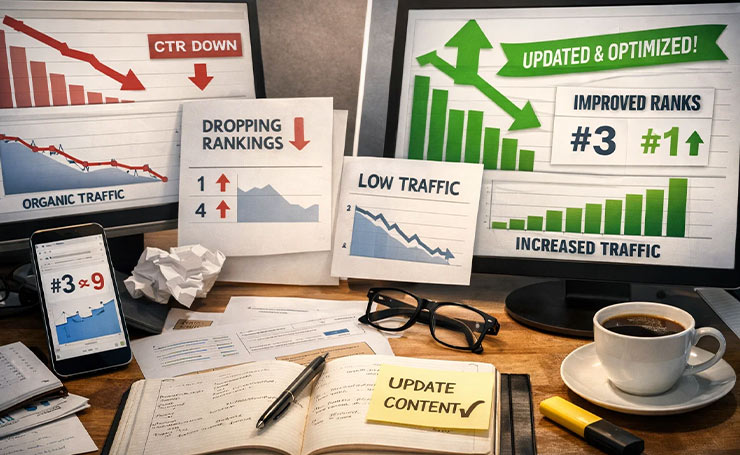
You will start noticing content decay signs, such as lower CTR, less organic traffic on some posts, and decreased search rankings.
The best part is that the content can be refreshed, updated, and optimized. In many cases, updating the old content regains rankings at a lower cost than creating new content from scratch.
Ad Fatigue
Ads lose their effectiveness when
- Audiences repeatedly see the same ad creatives
- Click-through rates start to decline
- Cost per click and acquisition increase
To fix ad fatigue, it typically requires
- Creating new ad creatives
- Adjusting audience targeting
- Increasing the budget to improve performance
- Pause the campaign for some time

Key Insight
Refreshing and optimizing content is usually more cost-effective and scalable than continuously replacing ad creatives to fight the fatigue.
Content Marketing Trends vs Advertising Trends
Take a look at the trends of both of these marketing tactics.
Content Marketing Trends
Content writing is now leaning toward depth, trust, and quality.
- AI-assisted content creation is becoming common, but with human editing and insights to stand out.
- Topic authority is ranking more over single keywords because comprehensive coverage is outperforming isolated posts.
- Experience-based content, as defined by E-E-A-T, builds trust and credibility.
- Search engines favor human-first content that delivers value, as it is designed to solve user problems.

Advertising Trends
Advertising is becoming more competitive and expensive due to platform and privacy changes.
- The cost-per-click is rising, particularly in competitive industries.
- Privacy regulations are becoming stricter, which limits audience targeting.
- Tracking accuracy is also reduced, making ROI measurement more challenging.
- Competition has increased, which leads to faster ad fatigue and declining efficiency.
What This Means for Marketers
These trends highlight why long-term strategies can be more effective. Advertising is great for short-term results, but content marketing provides a more sustainable growth. However, the ideal approach is always blending these two, according to your needs.
Which One Should You Choose?
Choose content marketing if
- You want sustainable business growth.
- You want to build authority.
- You rely on SEO.
- You want long-term results.
Choose advertising if
- You want fast results.
- You are launching a new service or product.
- You have a high budget.
- You want predictable lead volume.
Choose both if
- You want immediate and long-term growth.
- You want to test offers with ads and scale with content.
- You want maximum visibility across multiple channels.
Final Verdict
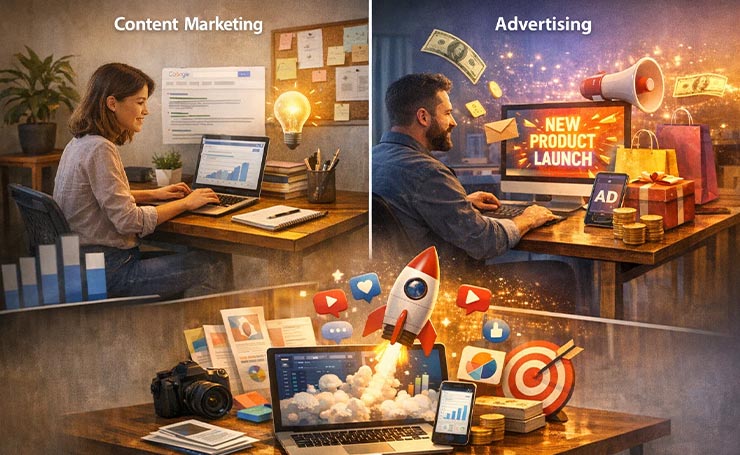
In the content marketing vs advertising debate, you need to understand that both of these are complementary tools. While advertising is responsible for delivering speed, content marketing delivers sustainability.
A smart decision for your business is to use both strategies: advertising to generate quick wins and content marketing to get long-term growth.
Take a deep dive into the digital world and its trends by visiting The Digital Advice.
FAQs
Is Content Marketing better than Advertising for Small Businesses?
For small businesses with a limited budget, content marketing is often better because it builds long-term organic traffic without continuously spending on ads. Advertising is still effective, but you should combine it with content to support trust and conversions.
Can Advertising Work without Content Marketing Support?
Advertising can work without content marketing, but it can be less effective in the long run. Without supporting content, like landing pages, blogs, or case studies, ads often struggle with trust, higher acquisition costs, and lower conversion rates.
Is Content Marketing Still Effective in the Age of AI?
Yes, content marketing is effective, but the focus has shifted toward human-first, experience-based content. AI can help with creating content, but you need originality, expertise, and real insights to stand out.
When should a Business Prioritize Advertising over Content Marketing?
A business should choose advertising when it needs quick visibility, such as when it launches a new product, offers a limited-time service, or runs seasonal promotions.