


15-Second Summary:
This blog post is designed to introduce you to International SEO, its benefits, domain name requirements for international expansion, Hreflang, and multilingual SEO implementations
This will help you reach a global audience from your target countries, increasing the potential of your business.
We will outline the best practices and tactics to cater to specific markets, along with technical setup tips that will help you provide a fantastic local experience to your target audience in different countries, while also allowing you to rank internationally.
What is International SEO?
If you have a website and need to offer your products or services to different countries worldwide, then International SEO becomes a top priority.
International SEO is the optimization of your website for different countries, whether you choose to target them with separate domains or by using Hreflang tags within a single website to create a multilingual platform that caters to the needs of potential target audiences in various countries worldwide.
International SEO basically comprises:
- Structuring URLs for different countries or different languages.
- Using hreflang tags for language targeting
- Creating content in different languages for various regions or countries, utilizing a localized keyword approach for each, ensures the right audience targeting.
- Ensuring that geo-targeted content is served in a way that maximizes global search engine visibility.
If you are someone who needs to expand into different regions and target countries with diverse languages and audiences, you must optimize for International SEO practices.
What Makes International SEO Important?
As an online business with the potential to operate in multiple countries and expand its global presence, increasing its revenues, International SEO has become essential.
With the help of a good Global SEO strategy, you ensure that search engines are providing the right content to the right audience based on their country and language.
Therefore, it does not matter whether you are an e-commerce store, a SaaS Platform, or a regular blog providing content; if you wish to reach a wider global audience, International SEO, along with Global SEO strategies, is what you should focus on.
Is International SEO and Global SEO the Same?
Although International SEO and Global SEO are sometimes used interchangeably, there is a distinct difference between them in terms of SEO strategies.
Global SEO is a broad type of SEO that targets a wider international audience with one-size-fits-all strategies. At the same time, International SEO is an optimization strategy that involves optimizing a website for multiple countries, adapting it to their respective languages.
| Aspect/Factors | International SEO | Global SEO |
| Defination | SEO strategy for multiple countries and multiple languages | Global SEO using a uniform SEO Global approach |
| Target Audience | People from target countries and regions | People all around the globe without a country of origin |
| Language Considerations | Multilingual content for different countries or regions | Using one language for all. Usually English |
| Technical Setup | Uses hreflang tags, local hosting/CDNs, and region-specific URLs | Using one URL and a general technical setup for all |
| SEO Goals | Increased visibility in multiple countries and regions | Global outreach and global visibility in search engines |
| Ideal For | Businesses targeting specific markets in specific regions | Businesses offering universal products or blogs with global outreach |
| Examples | Amazon has different domains for different countries | Spotify utilizes a single domain and the English language, with limited local SEO for targeting its audience. |
This table, entailing the key differences between the two SEO types, will help you understand the critical differences between them.
Highlighting this is necessary to avoid confusion between International SEO and Global SEO, as we are explicitly discussing International SEO in this context.
Now that we are aware of what International SEO is, its importance, and how it differs from Global SEO, let us begin learning the practices of International SEO, starting with understanding the three ways we can set up our website domains for International SEO before implementing our strategies.
Choosing A Domain Structure For International SEO
Before choosing your domain structure, consider whether you want to cater to different content for different countries or provide similar content in all target countries, but in various languages.
Based on this choice, you will then consider selecting a website URL structure that caters to your chosen languages and countries.
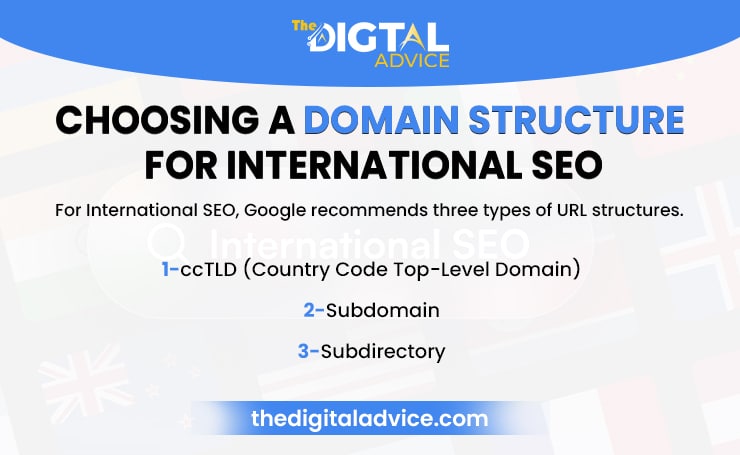
For International SEO, Google recommends three types of URL structures.
ccTLD (Country Code Top-Level Domain)
- This includes specific country-related domains, each catering to a single country.
- For example: amazon.us, amazon. In, etc.
- This is a highly effective technique for geo-targeting. Still, it is not feasible for small-scale businesses, as owning multiple domains and investing in their maintenance and SEO requires a significant amount of resources, which may not be accessible to small businesses.
Subdomain
- Subdomains are particularly useful when we need to maintain a presence on a generic top-level domain (gTLD).
- For example, fr.example.com (If you are targeting a country where French is spoken)
- These are generally easy to set up and help you target your audience for international SEO, although typically at moderate levels of effectiveness.
- Maintaining different domains means technical difficulties in managing multiple domains.
Subdirectory
- It is usually easier to manage and also SEO-Friendly.
- When you choose subdirectories for international SEO, you select a structure for your website that involves creating separate folders on your main domain and hosting them with different languages or content tailored for specific countries.
- For example, example.com/fr for French language content.
Usually, ccTLDs are considered the best URL structure option for massive website projects like Amazon, but based on the ease of use and fewer budgeting requirements, most prefer to use subdirectories because:
- Ranking is easier since all the backlinks are generated for one domain, thereby increasing its authority.
- It is cost-effective because you don’t have to create separate domains, making it more affordable.
- Hreflang is easier to implement, and Google can easily crawl and index the data, identifying the target language and country.
- You can easily monitor and track analytics reports under one domain, making it easier to audit and monitor for SEO purposes.
Although we have provided a brief description of each, along with suggestions on which ones are more suitable, you are not required to follow this recommendation.
You must analyze your business plans and consider the budget you have, and then choose your preferred URL structure to move forward with for international SEO.
International SEO Practices Checklist
Hreflang Setup For International SEO
When targeting different languages internationally, hreflang tags are used.
These are tags that tell search engines which language version of a page to display to its users. This helps to avoid the chances of duplicate content.
The basic syntax of hreflang looks something like this:
English – United States
<link rel=”alternate” hreflang=”en-us” href=”https://www.example.com/us/” />
French-Canada
<link rel=”alternate” hreflang=”fr-ca” href=”https://www.example.com/ca-fr/” />
Spanish – Spain
<link rel=”alternate” hreflang=”es-es” href=”https://www.example.com/es/” />
Default fallback
<link rel=”alternate” hreflang=”x-default” href=”https://www.example.com/” />
There are specific key points to consider when implementing hreflang in your website:
- Place the hreflang tag only in the head section.
- Use language-region codes correctly (e.g., en-GB, fr-CA)
- Ensure that you use a self-referencing hreflang code. It is essential for multilingual websites, as it tells search engines that your page is not just linking to other page versions, but it is also part of all the localized versions.
- Reciprocal links should be there between all of the alternate pages.
- Monitor hreflang issues regularly to detect and fix them in a timely manner.
- Use specialized tools to implement hreflang and audit them. For example, Google Search Console helps you to detect any hreflang issues, and Screaming Frog helps you to audit the tags as well.
Research Your Target Market
When targeting different countries, it is essential to understand your target audience.
The practical approach towards this is to assess your competitors. Examine the market share they hold in each country and the keywords they are targeting.

You must also consider the user intent of your target country and its audience so that you can set up your SEO based on your audience’s intent, relevant keywords for targeting, and competition.
Use Content Delivery Network
Implementing a CDN is essential because it helps speed up page load times, providing a better user experience.
By using a CDN, you can use a group of distributed servers. This helps store your content on local servers, allowing your target audience to access it from a local server instead of a centralized one, which results in quicker content access and a better user experience.
Website Speed
Optimize your website’s speed, as this is a high-priority ranking factor for search engines.
If your website loading speed is not fast and it takes more than 3 seconds to load, that could cause users to leave your website, increasing the bounce rate.
This negatively impacts your SEO and visibility, as search engines may not prefer to show your website in search results if they find it causing a poor user experience.
To improve your website speed:;
- Use a reliable hosting provider that provides fast speed and reliability. This ensures improved performance, which leads to better SEO and overall results.
- Optimize images by either using responsive images or compressing image sizes to avoid slow loading times, improving page loading speed.
- Enable browser caching.
- Optimize your website for mobile usage, as more than 60% of people use mobile devices to browse the internet. Hence, having a mobile-friendly website is essential, as Google now uses a Mobile-First ranking approach and ranks mobile sites based solely on their mobile preview.
Targeted Keywords Research
Keywords research is essential for International SEO. When targeting different countries, it is necessary to understand the user intent of each target country.
Based on language differences, keywords may vary, even if you are using English as your target language some terminologies will differ between the US and the UK. Therefore, keyword research is essential, even if you are targeting countries that use the same language.
You will also need to find local or geo-targeted keywords to personalize your content for specific countries, leveraging them for your International SEO success.
Keywords research is really essential for International SEO, and you must ensure you are not taking them lightly.
Content Localization
Content localization means adapting your content to resonate with your specific target market and audience.
- This involves using local or geo-targeted keywords implementation in your On-page SEO and location-based SEO.
- Incorporating Cultural nuance and language preferences.
- Focusing on the audience’s intent and search behavior to tailor content according to that.
Content localization offers a superior user experience, enhances your visibility in search engines, improves your search rankings, and drives high conversions in the international market.
Building Backlinks
Building backlinks is essential because it establishes authority and enhances your credibility. However, when targeting international markets and considering international SEO practices, having high-authority backlinks from your own country’s market is not enough.

You also need to obtain backlinks from each region and country you are targeting, especially when buying ccTLDs for specific countries or regions.
This means you need to obtain links from high-authority local websites and businesses in each country or region you are targeting.
Regular SEO Audits
Regular SEO audits are necessary to monitor your international SEO performance. Carrying out regular audits means finding and fixing any SEO related issues in a timely manner keeping your website performance on right track always.
Tools like Google Search Console, Google Analytics , and hreflang auditing tools can be used to motior your traffic for each region, including the indexing and ranking issues.
Final Remarks
International SEO practices are going to help you become more visible in search engine results, improve your search rankings, and help bring more conversions by increasing leads.
International SEO is essential for your website and business if you are considering expanding your business into different regions or countries and want to target audiences based on their language, cultural, and behavioral nuances.
You must ensure that you get your URL structure decision right, and once you are settled on it, following the International SEO practices mentioned in our blog post can help you set up your international SEO priorities correctly.
If you are interested in seeing how Local SEO and On-Page SEO work so that you can incorporate them into your Global SEO strategies, then feel free to explore our SEO blogs and enrich yourself with all the right SEO advice for all types of SEO.
Frequently Asked Questions
What is International SEO?
International SEO is the optimization of your website for different international markets based in specific countries or regions to which you are expanding your business.
You use hreflang, specialized domains, and a geo-targeted keywords strategy to optimize your website and its content, gaining increased visibility and rankings in search engines that lead to more conversions.
What’s the difference between International SEO and Global SEO?
In Global SEO, you are using a one-size-fits-all approach for a global audience. However, in International SEO, you target specific countries or regions based on their language and cultural nuances, utilizing content localization strategies.
Which domain structure is best for International SEO?
Recommending the best domain structure is not easy, as it depends on the resources a business has. If you have the budget and want to target each country with a separate website like Amazon, then ccTLDs are ideal for SEO.
However, if you have fewer resources, subdirectory domains are ideal, easy, and cost-effective for managing multilingual SEO.
Do I need different content for each country?
Yes, using the same content for different regions or countries can negatively impact your SEO.
Because with each different location, there is a different language and cultural nuance, which changes the user intent and behavior.
Using the same content for different locations with just translation can not only not cater to the right user intent but can also reduce relevance and result in poor engagement or even search penalties.
How do I track International SEO performance?
Tools like Google Search Console, Google Analytics , and hreflang auditing tools can be used to motior your traffic for each region, including the indexing and ranking issues.