

Your content only delivers value when it is mapped with the customer journey. What is that, you might ask? Basically, your customers go through different stages when they come across your brand. Some of them have just discovered your brand, some are considering taking your services, and some are already doing so.
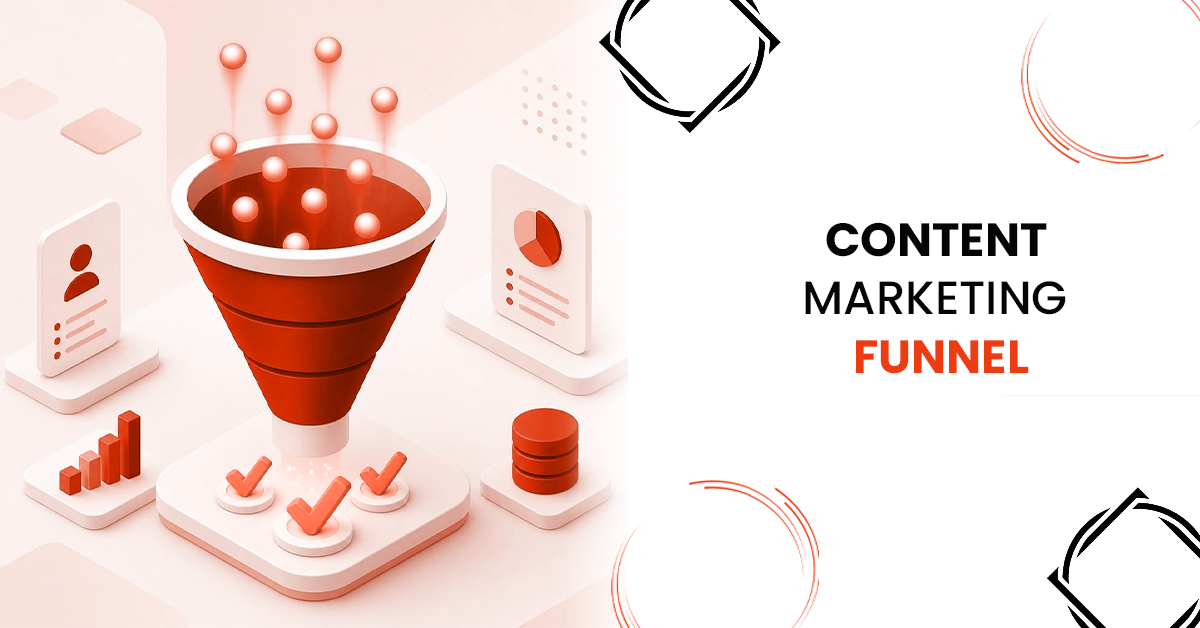
These stages are best visualized through a content marketing funnel. This is what we will walk you through in this guide, so that you start creating content that actually converts.
Key Takeaways

- A content marketing funnel aligns content with each stage of the customer journey.
- TOFU attracts and educates, MOFU focuses on building trust, and BOFU converts leads into paying customers.
- Gaps in funnel stages, particularly BOFU, often result in lost conversions.
- Optimizing content for intent and conversion improves ROI and long-term growth.
What Is a Content Marketing Funnel?
A content marketing funnel is a structure for creating content for your target audience at every stage of their journey, with the goal of guiding them to become paying customers.
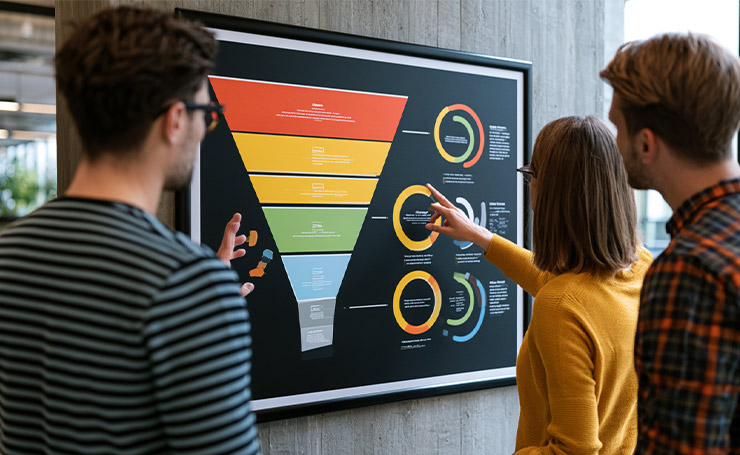
It is also worth remembering that not every lead goes through all the stages in perfect order. There might be a customer who is in the awareness stage and learns so much about your brand that they decide to become a paying customer directly.
The Three Funnel Stages: TOFU, MOFU, BOFU
Here are the three stages of the funnel.

Top of the Funnel
Top of the funnel, or you can call it TOFU for short, is where you build awareness among your target customers. At this stage, you highlight customers’ pain points and offer them a solution.
Middle of the Funnel
It is also called MOFU, and at this stage, you aim to generate interest among your audience regarding your products or services. You show them how your services or products can solve their problems, encouraging them to consider your brand.
Bottom of the Funnel
This is the last stage where you aim to convert your prospects into your regular clients. At BOFU, your audience has learned everything about your brand, so the content should be curated to encourage them to convert.
Let’s understand all of these stages in detail.
Top of the Funnel: Discovery
Goals: The business goals at TOFU include indirect customer acquisition, which needs improved search visibility and brand awareness.

Tactics: Content here should be educational and evergreen.
At this stage, your business is trying to raise awareness about its offerings among potential customers. If the use case of your product or service is not obvious, you need first to educate people that a certain problem even exists that needs to be solved.
Hearing your brand name is not enough. You need to create content that educates people (not promotional) and associates feelings of respect, gratitude, and authority with your business.
The content you need at this stage includes
- Blogs
- Videos
- Webinars
- Quizzes
- Detailed guides
- Tips
- Infographics
- Email newsletters
Content Metrics to Analyze

The metrics you need to monitor are
- Number of visitors
- Conversion rate
- Time spent on the page
- Number of leads
- Bounce rate
Middle of the Funnel: Consideration

Goals: At MOFU, the business goals are customer acquisition and educating potential customers.
Tactics: Content should have solutions to use-case challenges.
At this stage, your prospects often start associating your brand with the solution they are looking for. It is where you curate content that tells them whether your brand is a great fit for their needs.
Every content piece should speak directly to your audience and reassure them that it will assist them. Give them all the information they need to show how your brand is different from competitors.
The content at MOFU includes
- Case studies
- Product descriptions
- Testimonials
- Reviews
- FAQs
- Comparison content
- Statistics
Content Metrics to Analyze

Analyze the following metrics.
- Number of visitors
- Number of leads
- Conversion rate
- ROI (return on investment) or ROMI (return on marketing investment)
Bottom of the Funnel: Conversion

Goals: The business goal here is simple: to generate sales.
Tactics: Content should have complete product information.
The goal at BOFU is conversion. Your content should be straightforward and simply nudge them to press the buy button. It will be even more helpful if your content has a wow factor.
The content you need at this stage includes
- Success stories
- Sales copy
- Demos
- Pricing pages
- Calculators
Content Metrics to Analyze
Here, you need to analyze
- Conversion rate
- Number of payments
- ROI or ROMI
Building Your Content Strategy Around the Funnel
A strong content strategy starts with knowing what content you already have and where it exists in the funnel. This is why you should audit your existing content and map each piece to a funnel stage. You will find a heavy concentration at the TOFU stage and a near-empty BOFU. This imbalance is where pipelines fail.

Once you identify these gaps, plan your content around the search intent. TOFU content should target informational keywords, such as what is, how does, and best ways. MOFU content should align with high-intent transactional queries, like pricing, demo, hire, and agency.
For B2B content marketing specifically, account for longer decision cycles. A lead may go through six to eight pieces of content before filling out a simple form. Therefore, your strategy needs enough MOFU touch points, like case studies, email sequences, and comparison guides, to keep them moving toward BOFU without losing them to competitors.
Finally, build the strategy with consistency. Create a content calendar that deliberately assigns pieces to each funnel stage and review it monthly. It will outperform a reactive publishing schedule every time.
Conversion Rate Optimization Across the Funnel
CRO is not just a landing page concern. As you have seen above, the conversion rate comes in metrics for all funnel stages. At TOFU, the conversion is attention. A slow-loading page or a weak headline loses readers before they have started. So, optimize for page speed, readability, nd a clear next step at the end of every piece.

At MOFU, the friction points are forms and follow-ups. The lead capture forms should be short. Sometimes, a name and email are enough to start. Your email marketing sequences should provide value first and pitch second, or you will be dealing with multiple unsubscribes.
At BOFU, social proof becomes crucial. Testimonials, case studies, and star ratings near your CTA reduce purchase hesitation. Landing pages at this stage should be simple, focusing on one goal, one CTA, and proof that you deliver value. A/B test your headlines and CTA copy regularly, because small wording changes at BOFU can increase conversion rates.
Final Thoughts
A content marketing funnel turns random content into a system that results in your brand’s growth. Instead of publishing randomly, you create content that meets your audience where they are: discovering, considering, or ready to buy.
It is worth remembering that a funnel is not static. Customer behavior, market, and search intent keep changing. Therefore, perform regular audits, track performance, and optimize to ensure that your funnel continues to convert.
Interested in knowing more about Content marketing? Explore The Digital Advice for more blogs.
FAQs
What is the difference between a Content Marketing Funnel and a Sales Funnel?
A content marketing funnel focuses on educating and nurturing target audiences through valuable content. In contrast, a sales funnel is all about closing deals. Content funnels build trust first and make the sales process smoother.
How long does it take for a Content Marketing Funnel to start Generating Leads?
Results vary by competition and the industry you are active in. However, most businesses start seeing measurable increases in traffic and leads within approximately 3 to 6 months of consistent publishing and optimization.
What content works best for the BOFU (bottom of the funnel) to drive High Conversions?
Content that reduces customer purchase hesitation includes product demos, testimonials, pricing structures, guarantees, and strong CTA landing pages.