

Content marketing is not optional anymore; it has become essential for business. In 2024, nearly half of decision-makers increased their content marketing budgets. In fact, around 58% of companies across industries invest $ 5,000 to $10,000 in content marketing.
Why? Because traditional marketing is not enough now. People need content marketing to make their businesses thrive. In this guide, let’s explore what content marketing is, why it matters, and how it works.
Key Takeaways
- Content marketing is a long-term strategy that drives value and builds trust, authority, and sustainable business growth by attracting the target audience.
- Understanding your audience, creating buyer personas according to user intent, and proper customer journey mapping are important aspects of effective content marketing.
- Consistency, quality, and strategic distribution of the content matter much more than volume.
- Measuring performance and adapting with emerging trends (AI, UX, first-hand expertise, and community-led content) is necessary to stay in competition.

What is Content Marketing?
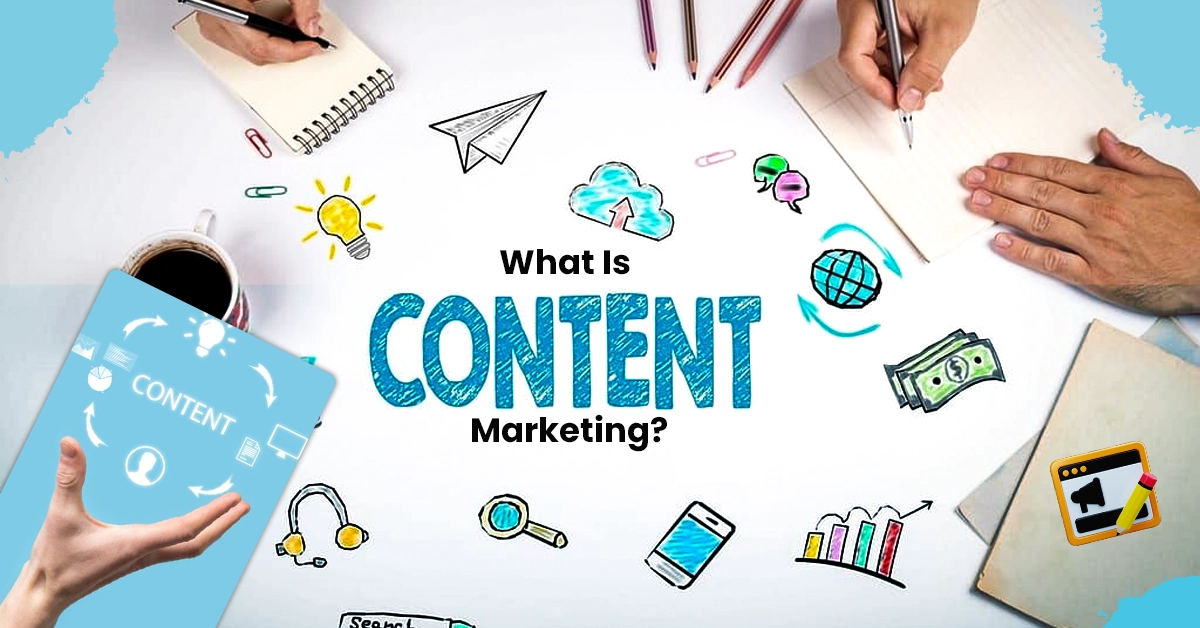
Content marketing is the use of valuable and informative content to drive the growth of your business. You design content in a way that persuades your audience to engage with your business.
Unlike traditional marketing, which pushes a message to consumers, content marketing attracts the target audience by educating them and building trust.

3 Key Elements of Content Marketing
- Content Creation: This is where you create content to engage your audience. It can be a blog post, a series of social media posts, a video, or a white paper. The focus here is on the content quality and relevance.
- Content Distribution: This focuses on distributing the content you created across platforms such as websites, newsletters, and social media to reach your intended clientele.
- Content Engagement: This element focuses on building relationships and encouraging valuable feedback that guides future content marketing strategies. Engagement can be through comments, shares, likes, and direct responses.

How Content Marketing Works
Content marketing has an essential role at every stage of the sales cycle, from initial awareness to purchase. Here is how content marketing works to engage and sell.

Awareness Stage
This is the first stage of the sales cycle where your content should only be about the concerns of your audience. To engage with your desired customers, you need to write about their queries, pain points, and challenges.
The best content for the awareness stage includes blogs, articles, videos, e-books, and newsletters.
Consideration Stage
In this stage, the content becomes a mix of helpful information and marketing. It should educate the audience on what features they should look for. The content should definitely lean toward your brand’s offerings.
The ideal content for this stage is case studies, how-to videos, how-to articles, worksheets, and checklists.
Closing Stage
This is the stage where the prospect is close to buying your service or product. The content should tell them why your offerings are the best choice for them. The central message at this stage should be your knowledge, expertise, and how you provide more benefits than others.
The right content for the closing stage is user-generated content, buyer’s guide, case studies, product video, and research report.
Why Content Marketing Matters Today?
The importance of content marketing lies in how people consume information today. It creates brand awareness and establishes the business’s authority. Around 82% of businesses use content marketing to attract their target audience.

Videos, a type of content marketing, have convinced 88% of people to buy a product or a service. This shows that content marketing clearly provides a competitive advantage to businesses.
Content marketing, when done right, provides benefits in different ways.
- It helps to become visible online through your website or social media.
- It helps you develop and nurture potential shoppers, generating significant leads.
- It encourages customers to make repeat purchases, developing loyalty.
- It builds authority and places your brand as the leader.
Content Marketing vs Traditional Marketing
| Feature / Aspect | Content Marketing | Traditional Marketing |
| Approach | Pull / inbound: attracts audience with value | Push / outbound: interrupts the audience with ads |
| Goal | Build trust, educate, nurture leads | Drive immediate sales or awareness |
| Audience Engagement | Two-way, interactive, long-term relationship | One-way, transactional, short-term |
| Cost | Often lower, scalable over time | Usually higher (TV, print, billboards) |
| Measurement | Measured via engagement metrics, leads, and ROI | Measured via reach, impressions, and ad recall |
| Content Lifespan | Evergreen content can perform for months/years | Ads run for a limited time only |
| Examples | Blogs, videos, podcasts, social media posts | TV commercials, print ads, direct mail |
| Focus | Value-driven, customer-centric | Promotion-driven, product-centric |
| SEO & Organic Traffic | Supports search visibility and inbound traffic | Minimal effect on organic search |
Types of Content Marketing
Understanding the various kinds of content marketing is important to create a well-rounded strategy.
Blog Posts
Blog posts are a powerful way to generate leads, get more traffic, and establish authority in your industry. These allow you to boost your website’s search engine rankings and make it easier for target customers to find you.

Video Content
Videos have become an important part of a content marketing strategy. Around 91% businesses use videos as a marketing tool, and 93% of video marketers think videos are essential for their strategy. From short clips to long-form videos, brands should simplify complex ideas to encourage engagement.
Social Media Content
Millions of people use social media as a part of their daily lives. Producing content to attract audiences on social media platforms, like Facebook, Instagram, X, LinkedIn, and TikTok, is important. Ad spending on social platforms is expected to reach US $317.33 billion in 2026, showing the immense value and power of social media.
Podcasts
Podcasts are another great way for lead generation and audio content creation. You can share in-depth discussions, stories, and interviews through podcasts. As it is a convenient way for listeners to consume content on the go, it boosts loyalty and builds authority.

Infographics
Infographics are excellent as they change complex information and data into visually appealing, easy-to-digest content. Most businesses incorporate infographics and find this medium effective for high engagement.
Email Marketing
Email marketing is excellent for reaching your target customers directly. The average return on investment on every dollar spent is $36. Apart from significant ROI, email marketing is also great for audience targeting, nurturing leads, and retaining customers.
White Papers
These are long-form content pieces that provide in-depth, detailed information on specific topics. They are extremely valuable in B2B marketing. Around 67% successful businesses incorporate white papers into their content marketing strategy.
B2B vs B2C Content Marketing
Here is how B2B and B2C content marketing differ.
| Aspect / Feature | B2B Content Marketing | B2C Content Marketing |
| Audience | Businesses, decision-makers, professionals | Individual consumers |
| Buying Cycle | Longer, research-heavy, multiple stakeholders | Shorter, emotional, often impulse-driven |
| Content Focus | Educational, solution-oriented, ROI-driven | Entertaining, engaging, emotion-driven |
| Content Types | Whitepapers, case studies, webinars, eBooks | Social media posts, videos, blogs, contests |
| Tone & Style | Formal, authoritative, data-backed | Casual, relatable, storytelling-focused |
| Distribution Channels | LinkedIn, email newsletters, industry blogs | Instagram, Facebook, TikTok, YouTube |
| Measurement | Leads generated, pipeline influence, and content marketing ROI | Engagement metrics, shares, brand awareness |
Understanding Your Target Audience
Understanding your intended audience is crucial in content marketing strategy because it tells you how you can make it relevant, engaging, and effective.
Why Audience Research Matters
Audience research is the foundation of your content strategy. It enables you to segment your potential audience by demographics, psychographics, and behavior, and to understand the challenges they face and how they consume information.

Audience insights also inform you about tone, format, and distribution of the content. Without it, businesses might create content that is too general, too promotional, or completely out of sync with their potential customers. The result is wasted efforts and lower returns.
Buyer Personas
Another amazing tool in audience research is a buyer persona. It is a semi-fictional representation of your ideal audience based on deep market research and real data.
A well-defined persona lets you create more targeted content that resonates with the audience you want to attract. It lets you tap into your audience’s motivations, goals, behaviors, and challenges and helps you humanize them.
Customer Journey Mapping
Based on the buyer persona, customer journey mapping visualizes the entire process a potential consumer goes through from initial brand awareness to purchase and beyond. It shows touchpoints, emotions, and decision moments as target customers interact with your brand.
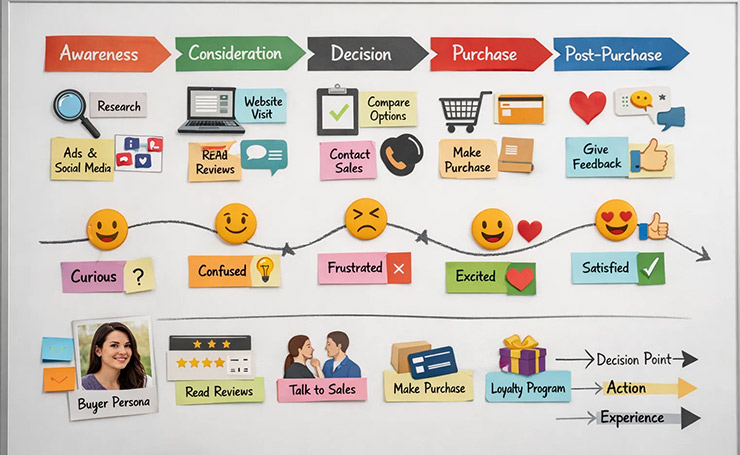
In short, customer journey mapping not only tells you who your customer is, but also how your customer thinks and acts at every stage of their buyer journey.
Pain Points and Intent
Understanding your audience’s intent and pain points is important because your content aims to solve their problems rather than just telling them about your offerings.
Pain points refer to all the challenges, frustrations, and unmet needs that drive your target customer to seek a solution. Intent focuses on what users are trying to accomplish when they search, click, or consume content.
Regularly updating your understanding of the audience’s intent and pain points keeps your content relevant and reliable.
Funnel Stage Content
After understanding your audience personas, intent, and pain points, brands start creating content according to each funnel stage. The stages are TOFU (stands for top of the funnel), MOFU (stands for middle of the funnel), and BOFU (stands for bottom of the funnel).
The content at TOFU is all about educational resources and addressing problems your audience faces. In the MOFU stage, the goal is to engage and nurture users with more detailed insights and comparisons. Lastly, in the BOFU stage, content should help your target users make decisions by offering testimonials, demos, and value propositions.
A brand should align its content strategy according to these stages and guide the audience from curiosity to confident decision-making.
Creating a Content Marketing Strategy
An effective content marketing strategy needs careful planning and execution. Here is how you can achieve a successful strategy.
- Set Clear Objectives: Before starting, establish your company’s goals: whether you want to increase sales, create brand awareness, or generate more leads.
- Understand Your Audience: Develop detailed buyer personas to truly understand your audience’s needs and tailor content that resonates with them.
- Plan and Create Content: Plan and create content according to each funnel stage. Focus on quality, value, and relevance.
- Choose the Right Platform: This step is important in content distribution. Choose the platforms where your target customers are most active. Make sure that the content reflects the expectations and style of each platform.
- Be Consistent: Consistency is critical if you want to see significant results. Use a content calendar to maintain a regular publishing schedule. Consistent publishing ensures that your brand remains trustworthy and stays at the top of the audience’s mind.
- Measure Success: Keep tracking important metrics like leads, traffic, and conversions to see how your content is performing on each platform. Review and change your strategy based on this information to achieve your goals.

Content Creation Best Practices
- Always create a clear strategy that is relevant to your audience and helps them understand your brand and offerings.
- Invest a lot of time in keyword research. You can use different tools for this. Also, you can use existing information, like customer reviews, feedback, and comments, to answer any common questions and topics that come up.
- If you want to create a solid following, establish a consistent publishing pace.
- Your target audience should always be at the top of your mind when you are creating content, so you can connect with them.
- Do not create content that is so rigidly SEO-optimized that it feels robotic. You can satisfy SEO while also keeping your piece of content enjoyable for the audience.
- Keep updating your older content. Refreshing it can be just as effective as creating new content.
- Be aware of the Google algorithm updates and changes. Also, make sure that your content complies with E-E-A-T (Experience, Expertise, Authority, and Trust).
Content for Lead Generation and Sales
Content marketing lead generation involves developing a strategic approach that creates and distributes relevant, engaging content to attract and generate leads from a specific group of people.
Content-driven lead generation basically involves providing high-quality content in exchange for user information, such as their email addresses. Gated assets like templates, eBooks, reports, and webinars are commonly used for this purpose.

Moreover, strong calls-to-action and optimized landing pages are also essential to convert visitors into leads.
Content for Nurturing Leads
Capturing leads’ interest is the first step. The second step is to nurture them and keep them engaged to guide them closer to a purchasing decision. Email marketing is a great approach for this purpose, as it is used for personalized and timely content based on customer behavior and interests.
Nurturing content includes educational emails, product use cases, success stories, and industry insights. The main goal is to address concerns and stay at the top of customers’ minds by building long-term trust and not being very promotional.
Sales Enablement Content
This type of content supports sales teams to close deals more effectively. Content majorly includes one-pagers, pitch decks, competitive comparisons, customer testimonials, and ROI calculators.

Sales content should be well-designed to ensure consistent messaging and equip sales teams with the information they need to address any customer questions and objections.
Content for Customer Retention
Content marketing does not end when a business closes a deal. Its focus becomes retaining that customer and increasing lifetime value for them. The retention-focused content includes onboarding guides, how-to tutorials, newsletters, product updates, and exclusive content for existing customers.
Businesses can easily encourage repeat purchases and customer loyalty to the brand by continuing to educate and support their clients through proper content.
Measuring Content Marketing Success
Content marketing metrics are important to understand which parts of your strategy are working and which parts need optimization. Here are some common metrics that content marketers track.
- Website traffic: It shows the influence of your marketing strategy on paid and organic traffic. You can track it by identifying the growth in visitors, page views, and unique visitors.
- Lead generation: See how your content marketing strategy is generating warm and cold leads that you can push further through your sales pipeline.
- Conversion metrics: Monitor how the content strategy influences customers to take a desired action, such as clicks, sign-ups, form submissions, or purchases.
- Engagement metrics: Monitor engagement metrics, including scroll depth, bounce rate, time on page, and social shares, to understand how visitors respond to the content.
- Cost metrics: Track how much money is spent to achieve your marketing goals, such as cost per lead (CPL), cost per acquisition (CPA), and cost per click (CPC).
Content Marketing Tools
Before learning about the content marketing tools, it is important to understand what features you should look for in them. Here are some features that separate genuinely good tools from pretenders.

- A good tool has all the features suitable for its niche within content marketing. Whether it is for social media, email marketing, or SEO, the features of a great tool solve real-life problems.
- The best platforms are easy to use and feel intuitive from the start. They are also easy to integrate with your existing marketing stack.
- They offer flexible pricing structures to accommodate different budgets. Also, their premium tiers offer premium results.
- These tools are scalable and built to grow and adapt to your changing content needs.
The Best Content Marketing Tools
- Ahrefs: It is best for SEO and competitor analysis. It offers a comprehensive set of tools that cover almost every aspect of SEO.
- Canva: This popular platform is great for visual content creation. It offers professional-looking visuals that are simple to create, even without any prior design experience.
- Hootsuite: For social media management, this platform is ideal. It offers advanced reporting and brand monitoring features.
- Page Optimizer Pro: This tool helps in content optimization and offers AI-driven recommendations and insights.
- Hemingway Editor: It is an excellent tool for AI-assisted writing. It offers recommendations to make your writing concise, clear, and easy to read and understand.
- Mailchimp: This platform offers an intuitive email builder and comprehensive automations for effective email marketing.
- Jasper: You can use this tool for AI-writing. It is built to generate content tailored to different brand voices.
- Capsule: It is an AI-powered app that speeds up video editing, making video marketing easier.

Advanced Content Marketing Strategies
Content marketing changes fast, so should your strategies. Here are some advanced strategies you should know to achieve desired results.
Data-Driven Approach
Modern content marketing is all about data and analytics. Instead of relying on intuitions, effective strategies are based on performance metrics. Marketers now see how audiences interact with specific content and optimize their strategy accordingly.

Personalization
In modern content marketing, personalization is not “just nice to have,” it is expected by your target audience. Using AI and automation tools ensures real-time content variations that adjust to user behavioral signals.
Community-Led Content
Content is not just a one-way approach. Now the audience wants to participate and co-create. Community-led content invites audiences to share their stories and perspectives. This strategy outperforms purely brand-created messaging in trust and engagement.
Content Marketing 2026 Trends
Looking ahead to 2026, several key trends are set to shape the direction of content marketing strategies. Here is what to look forward to.

- AI-enhanced content will be used in content marketing. Although it is an excellent opportunity to differentiate your content, you need to strategically implement it to avoid basic AI writing.
- The most important way to build trust with your audience is going to be prioritizing people over your brand.
- The main focus will be on user experience because it can influence your search rankings and separate your posts from generic AI-written ones.
- First-hand expertise will be given priority because it gives brands an opportunity to stand out on subject matters that they are experts in.
- You will see a lot of content repurposing, as it is an excellent way to get more value out of each piece of content.
- Podcasting is going to flourish in 2026 when executed strategically. It will help you reach new and wider audiences.
- Email marketing is still one of the most important trends because it is a stable way to grow your business and generate more sales.
Wrapping Up
Every modern business needs to understand what content marketing is to thrive in today’s world. When you provide value-driven content with strategic planning and consistency, you are able to build trust with the audience, increase your brand’s visibility, and achieve long-term results.
Learn more about the evolving digital world by visiting The Digital Advice.
FAQs
1. What are the 5 Pillars of Content Marketing?
The five pillars of content marketing are understanding your target audience, developing content according to the customer’s journey, creating valuable content, promoting your content on the right platforms, and measuring the results.
2. What are the 5 C’s of Content Marketing?
The 5 C’s of content marketing that every brand should remember are: Clarity, Creativity, Consistency, Conversion-focused, and Customer-centricity.
3. What are the Best Tools to Manage Content Marketing Campaigns?
The best content marketing tools are those that are suitable for your workflows. However, the commonly used ones are content management systems (WordPress), project management tools (Asana, Trello, Notion), and SEO tools (Ahrefs, SEMrush, Google Search Console). For email and social media scheduling, use Hootsuite, HubSpot, and Buffer. Some good analytical tools are HubSpot and Google Analytics.
4. How do you measure ROI on Content Marketing Efforts?
You can measure ROI by comparing the revenue generated to the cost of content creation and distribution. Metrics you should monitor include lead generation, organic traffic, customer acquisition cost, conversion rates, and assisted conversions. Use Google Analytics and CRM data to track these metrics.